Wednesday, August 6, 2014

Growing Brood

Summer is baby bird season, and in the backyard, that means coveys of baby California quail. Earlier this summer we thought we'd missed the neighborhood quail family, but it seems they were just a bit later than usual, for one day we were inundated with a flock of fluff - at least seven or eight chicks trailing along with their overly cautious parents. Barely tall enough to investigate the flowers along the neighbor's wall, they still skittered energetically over the grass, peeping all the way.

As the weeks have progressed, so have the quail. While not all have survived - the covey has dwindled to six healthy chicks that seem to be doing well, which is still a good survival rate for the flock - they are growing, and each week they are larger and show clearer markings. They now come onto the deck readily, pecking about for seed and hopping up and down, up and down on the stairs. They haven't yet mastered getting onto the taller feeders or up on the railing where the largest platform feeder rests, but that's a good lookout point for daddy quail, while mummy generally stays closer to the brood. Not quite teenagers, they're in that awkward adolescent stage that is no less endearing than chickhood.

Soon enough the youngsters will be indistinguishable from their parents, though the flock will remain together through the cooling autumn and into winter's snows. They're all welcome, and I hope that next summer they all manage to raise even more chicks to come for a visit.

Friday, August 1, 2014

A Fabulous New Feeder

 A few months ago, I lost my largest bird feeder - a 2-in-1 Triple Tube Feeder - that featured a huge capacity, attractive design, and many feeding ports. I wasn't too upset with its demise, since it had been in constant service for close to three years, in weather conditions ranging from full sun in up to 100 degree heat in the summer, to zero degree temperatures and covered with snow in winter, and it served me well. The threading on the screw holding the top to the rest of the feeder finally cracked enough that it couldn't be hung, and it was time to choose a new feeder.

Reviewing bird feeders is part of my work with About.com, and I regularly examine different sizes, styles, and designs, but despite my familiarity with many feeders, it's difficult to choose a new one for my own yard. After a long time examining the options, I finally selected the Bird-Safe Platform Feeder from Duncraft, and even though I was familiar with the feeder after having reviewed it, putting it up in my yard has drastically surpassed all my expectations.

I hung the feeder from the rain gutter at the edge of my covered deck, and it took less than a day for the birds to discover the new bounty (I have other feeders in the same area). And discover it they have! I fill it with a half-cup of hulled sunflower each morning, and all day the feeder is patronized by a variety of species, including:


Interestingly enough, to date I have never seen a single house sparrow at this feeder, though I have dozens of them at my other feeders (including on the deck not five feet away), and the slant of the roof apparently also keeps the Eurasian collared-doves and mourning doves away from the feeding tray, allowing the smaller birds to enjoy the food without unfair competition. For anyone who may be troubled by bully birds, I strongly recommend giving this feeder a go. Admittedly, I haven't had it in strong rain or a cold winter yet, but it has so far been outstanding. I can't wait to see what birds arrive for the next meal!

Sunday, July 27, 2014

New Birds in New Mexico

Spring is always a hot birding season, and this past spring I finally got to take advantage of some minor spring birding with a trip to New Mexico. While the trip was not primarily for birding, there was still time for a few minor birding stops in Albuquerque and slightly south of the city. A good many southwestern birds - Gambel's quail, greater roadrunners, and others - were part of the scene, but while it was a shade too early for most migrants to make an appearance, much to my dismay, one local resident did make my life list.

Of course, it happened as it has all too frequently - too much time straining for unsatisfying views that finally result in a disappointing lifer, for while I'd seen all the requisite field marks, I didn't feel I'd really enjoyed a good view of the bird. Then, naturally, the next day in a far easier place, the bird reappeared with tantalizingly good views and a far more cooperative nature. Either way, though, I was able to add the black-throated sparrow as a lifer. It's an attractive sparrow and one I've been eager to see for years, and I'm glad for the opportunity.

In addition to a wide range of birds, particularly at a grand city park that was far more enjoyable than I'd anticipated, I also saw an amazing coyote, a variety of turtles, and great New Mexico culture and nuclear history. From hot air balloons to arroyos to distinguished architecture to nuclear test sites to radio telescopes, this is an area of the country I hope to visit again, for longer, and in more detail.


Wednesday, July 23, 2014

Gambling

My family and I travel to Las Vegas frequently, and while Sin City is well known for lost wages and loose morals, it's always a jackpot for birding, as it was earlier this summer. While I'm long past the stage of hoping for any lifers in the city (I've traveled there multiple times and often bird in the same regular hotspots), it's always a treat to see the southwestern birds that don't make it as far north as my Utah backyard.

On the way south, we typically enjoy a leg-stretching stop at Tonaquint Nature Park in St. George, a small but thriving property with beautiful habitat for a wide variety of birds. While the pond was surprisingly overrun with algae this time, the ducks and mute swans didn't mind, and the Indian peafowl roaming the park were a loud surprise. The adjacent cemetery is a relatively reliable spot to see Say's phoebes, and fledgling American robins were abundant near the playgrounds and picnic areas. I enjoyed renewing my acquaintance with Abert's towhees, and the blue grosbeak was a rare surprise just before getting back in the truck to continue the drive - after a brief stop for gas and watching a family of rock wrens near the station.

Once in Vegas, there was good opportunity to study a greater roadrunner that was hanging out at Sunset Park, and a flurry of active verdins were scattered all over the park as well. A crissal thrasher was another great sighting, and I enjoyed the black-tailed gnatcatchers and the Gambel's quail, so similar to my backyard California quail. And Vegas wouldn't be Vegas without great-tailed grackles making a racket. While the waterfowl weren't as numerous as I'd hoped at the pond section of Sunset Park, the double-crested cormorants, American coots, and Canada geese were still pleasant to see, and the western grebe out in the center of the pond was a treat.

Birding in Las Vegas changes from season to season, and while one's luck may change with what species are seen, if you visit the right places in the city, you'll be sure to come away a birding winner.


Saturday, July 19, 2014

(Sage) Grousing

Spot the greater-sage grouse.
Despite the inner darkness, there have been moments of lucid light in the past few months when the birds fly into my consciousness. One of the briefest was in April, when I finally managed to add the greater sage-grouse to my life list.

Getting these wary gamebirds as lifers isn't so much birding as it is a quest. For me, it began at four in the morning (so not my idea of a good birding time), with a nerve-wracking drive through pitch black canyons and with somewhat vague directions. Admittedly, the directions were fairly spot-on, but to me, being unfamiliar with the area they led me to, they were vague enough for apprehension. Yet I did manage to arrive at the Henefer lek as dawn was breaking over the eastern horizon, and as I crept closer to the marked fence - windows rolled down - I could hear the distinctive "popping" of the air sacs as males vied for the admiration of the all-too-uninterested females.

The one-way drive took roughly 75 minutes, but within two minutes of arrival, I had the lifer I sought. Good thing, too, because less than five minutes later, an asshole of a golden eagle overflew the field, and the grouse scattered to the southeast, not to return. I'm glad I arrived when I did, and I'm glad I got at least a minor view and heard the birds as well, giving me the lifer to count. And for the record, I don't really think golden eagles are assholes, but he couldn't have waited a few more minutes?

I did stay in the area for a bit after the grouse had flown their figurative coop, and was rewarded with a few other good birds - some beautiful morning songs from western meadowlarks, and the early morning foraging of a variety of sparrows. It was disappointing to make the long drive home after such a brief birding, but still, the birds and I did manage to cross paths at least for a moment.

I'll be back on this quest next spring, I think. While I have the lifer, it's what is known as a BVD - better view desired. I'd love to see the birds more closely, and for more than a few moments. The drive might be harrowing, but in the end worthwhile.

Henefer lek at sunrise, through a dirty windshield (don't get out of the truck, it might disturb these sensitive birds).

Monday, July 14, 2014

A Very Dark Place Without Birds

I miss birds, and I miss blogging about them. But there are very few nocturnal birds in my area, and I've been in a very dark place for many months now - my own, personal nighttime where birds don't fly. There have been a lot of issues and both major and minor crises recently with work, family, and health that have sapped energy and drained enthusiasm, yet along the way the memory of birds does still make me smile, and I hope to fly again. It won't be today, and it likely won't be for a few weeks yet.

That isn't to say that there haven't been birds in the interim; there have been lucid moments when my backyard birds make me laugh - the oblivious house sparrow interrupting the amorous advances of a Eurasian collared-dove, the brief appearance of this year's spring hatch of California quail, the incessant demands of western scrub-jays when there are never enough peanuts - and I treasure those moments. I've been privileged to enjoy a rare press trip to a new destination and add lifers to my ongoing list, and I've also seen how birds help others, with pet bird aviaries in nursing homes and feeders that brighten elderlies' days. It makes me consider how helpful birds can be to all of us.

My wings are broken, the sky is out of reach, the wind not strong enough to lift my bruised and battered body. But I will heal, and I will stretch my wings again.

Thursday, May 22, 2014

Owl Action

Admittedly, it's been a long time since I've posted, and my bird action has been erratic at best, while the flight paths of my thoughts are equally erratic. But there have been good moments, learning moments, and teaching moments. One of them in recent weeks comes to mind...

There is a western screech owl in our neighborhood, and I've seen him a few times. Most recently, he visited my yard in a most insistent manner - despite my curiosity and enthusiasm for photos (which didn't turn out particularly well, as you can see), he was determined to stay nearby, flitting between the fence on the property line, to the pole that holds a feeder or two, to a tree near the kitchen window that holds another feeder. But owls don't eat birdseed, so why wouldn't he leave? Mind you, I was thrilled for the guest, but confused about his unusual behavior.

Confused, that is, until another piece of the puzzle fell into place. I have mouse traps on the deck regularly (mice are a fact of life with platform feeders), and after watching the owl for several minutes and several angles, I thought to glance at one of those traps - and it wasn't empty. It wasn't filled, either, not completely - a mouse had been caught by the tail but was still alive, and the owl was obviously aware of the prey and its availability. What amazing hearing owls have, as I was far closer to that trap several times than the bird, yet I never heard the mouse nor suspected its presence. Yet the owl knew, and wasn't giving up!

Obviously, both the bird and the mouse couldn't win the standoff. I had to give props to the bird, but I gave the mouse the tiniest bit of a fighting chance, and we released it in the yard, enough of a distance from the owl that it could run. It didn't run far, but it chose the exact wrong direction, and the owl got an easy meal that night.

What a wonderful experience, and one few birders get without provocation. I was in no way baiting the owl and deliberately attempting to draw it in with incapacitated prey (the mouse was genuinely caught, though I'd far prefer not to have mice nearby at all), but with the opportunity, I had to enjoy it. I'm sure the mouse didn't, but you win some and lose some.

Owl - 1, Mouse - 0.

Friday, February 21, 2014

A Little Thinking on Juncos

It has been a strange winter - very early and fierce in December, then holding back for just a few random storms, but we haven't had much snowfall or bitter cold in over a month. This does not bode well for summer - fire risk and drought are sure to be extreme - but for now, I'm thinking beyond the snow, to the snowbirds.

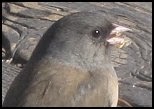
Some areas are privileged to have visits from dark-eyed juncos year-round, but these small, perky sparrows only seem to visit my deck and feeders when there is snow on the ground. It is amazing how well they match their snowbird nickname - when the snow vanishes, so do they, but if there is just a little dusting of white powder, they will be back, with a vengeance. For now, it seems as though they're gone for the season, and I miss their feathery tracks on the deck, their energetic hopping on the stairs and their voracious appetites for small seeds. It may be months before they reappear, but when they do, I'll happily brave the snow and cold to keep their feeders full.