Showing posts with label Cassin's Finches. Show all posts

Sunday, April 17, 2011

A First Sign of Spring

Despite it now being mid-April, winter has been protracted this year and spring isn't as advanced as you would expect. The weather is warming and flowers are beginning to bloom, however, but most trees are holding tight to their winter hibernation, at least for the moment.

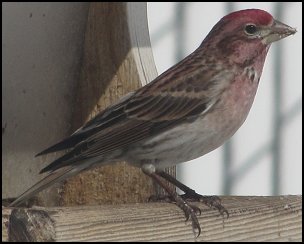
Still, I saw the first sign of spring in my backyard several days ago with the reappearance of the Cassin's finches - at least two pair, with the brightly colored males and boldly marked females both visiting the feeders and snacking on hulled sunflower seed. Theoretically, Cassin's finches are found in Utah year-round, but that has never been the case in my yard. They will visit for a few weeks to take advantage of the food and shelter I provide, but as the trees begin to embrace the warming season they will disappear to better nesting areas and more natural food sources.

Despite the season's delay, migrants are starting to appear - I've noticed a few yellow-rumped warblers flitting about the trees nearby, and the numbers of birds at my feeders are beginning to rise. Hopefully this pause in the season will be over soon, and I'll have more than the one rosy sign of spring my yard has thus far seen.


Tuesday, April 7, 2009

Sunshine

So much has been happening in the backyard in the past few days - the landscaping has finally begun - that I've fallen a bit behind in sharing all the great backyard bird news. The tidbit I want to share today has been a ray of sunshine into my yard several times now, in the form of an extremely rare yellow Cassin's finch.

Cassin's finches are most notably red, with a bold red cap and a lighter red or rose wash along their flanks. They are slightly larger than house finches, but they are often confused for them by unwary birders. I saw my first Cassin's finches just last year when they visited the yard in droves in early spring, and I was delighted to see them return a couple of weeks ago, albeit in small numbers (and still few at the moment). What surprised me most, however, was the yellow member of the flock.

House finches regularly appear in shades from red to yellow, including a bold orange, so I'm never surprised to find them in a rainbow of colors, but the yellow Cassin's variant is so rare that it isn't mentioned in most field guides. The only one - after hunting through several that I already own as well as at local bookstores - that gave even a minor mention of a yellow Cassin's finch is the complete Sibley Guide to Birds, which I've promptly ordered and am now eagerly awaiting its arrival.

This new visitor is most welcome, as are all backyard birds - even while my backyard is, at the moment, indisposed with landscaping projects half completed. There is a lesson here for all birders: no matter how well you may think you know a bird species, they can always surprise you, whether with unusual plumage, unique behavior, or just by bringing you a smile when you least expect it. As for me, Sunshine still makes me smile whenever he visits.

Friday, March 27, 2009

Backyard Bonanza

Today was quite the day for visitors to the backyard, despite the fact that I refused to refill the six now empty feeders only one day after they were all bursting with seed. (For small birds, pine siskins are absolutely voracious.) Nonetheless, the bright but chilly day, the spilled seed on the ground, the dregs in the mesh nyger sock, and the heated birdbath attracted quite the menagerie:

  • Cedar Waxwings
  • Pine Siskins
  • Lesser Goldfinches
  • American Goldfinches
  • American Robins
  • Mourning Doves
  • Eurasian Collared Doves
  • House Finches
  • Cassin's Finches
Despite the fact that the ducks did not come calling today, I don't believe I've had a birdier day in the backyard. And there are amazing observations that accompany such a flock...
  • You never know when, nor for how long, a unique visitor will appear. I happened to be working at the dining table this morning, and while doing so I'd moved my chair to easily see the feeders and watch the fun. I was astonished to notice a small flock of cedar waxwings alight in the trees bordering our northern fence, and even more astonished when they came into the yard to visit the birdbath. They were only there for a few minutes, and if I'd been working in my office on the other side of the house I'd have been none the wiser.

  • Water is an irresistible attractor. Every one of the bird species that visited today stopped for a sip from the concrete birdbath, but the cedar waxwings and American robins weren't the least bit interested in the available seed. If you truly want to attract the widest variety of species to your yard, you definitely need to have water available. And this was just from a still birdbath (and one that was none too clean at the time) - I can hardly wait to see what happens in a couple of weeks when the new fountain is installed.


  • The smaller the bird, the bigger the attitude. The pine siskins are some of the smallest to visit my feeding areas, yet they are the most vicious and temperamental of the entire mixed flock. They will snap at other birds, including other siskins, as well as beat them with their wings and engage in spectacular aerial dogfights (birdfights?) complete with an unrelenting barrage of buzzes, chirps, and chatters. The result? A momentary monopoly on the feeder - almost invariably the nyger sock - until another siskin decides to take on the challenge for feeder dominance.

The most important thing to learn from so many visitors, however, is that there is always something new to observe and you can always care for every bird. Every day I'm amazed at the birds that will make eye contact with me, chirp at me, and even buzz me while I'm refilling the feeders or scrubbing the birdbath. While some may think they're simply being territorial and reacting to a perceived menace, I believe they do recognize me and our fondness is - at least at times - mutual.

That, or I simply need to refill the birdfeeders more often. Happy birding!

Tuesday, March 24, 2009

Just Ducky

I've always been thrilled that our neighbors, whose backyard is far more developed than ours, have a pond, but never more so than today. Not only have the mallards returned, but they've brought a friend: a wood duck. All four, for the wood duck has apparently paired up with one of the mallard hens in a cozy way, visited our yard today, and I obligingly provided a treat of whole grain bread.

Wood ducks are stunning creatures, quite possibly one of the most beautiful native duck species in North America. Aptly named, their exotic coloring and stark, bold markings make them appear to have been carved from fine wood. As I learned from this afternoon's observation, however, they can also have quite the territorial attitude and do not tolerate any other male's attention to their perceived companions. Time will tell, of course, if this pairing is meant to last.

While all four of the ducks enjoyed the bread scraps, they also proceeded to snack on the black oil sunflower seed and millet. Not only would they take it from the ground, but one pair quickly found the recently filled platform feeder and decided that it was more convenient than ground feeding. They both tasted the peanuts, but wisely decided they weren't as tantalizing and left them for the scrub jay, who also visited this afternoon for his own treat.


The backyard excitement didn't end there, either. Earlier today, I spotted the first of the returning Cassin's finches. There is also an unusual yellow marked bird that has stumped my identification techniques; I've asked Bill Fenimore for assistance on that one and will spread the word as soon as I know. With all the excitement that I've had today, I hope your backyards are just as entertaining!

Sunday, April 27, 2008

Adding to the Menagerie

A new visitor has appeared at the feeders with a vengeance: Cassin's finches. At first, they appear similar to the common house finches, but they have several distinct characterisitics that help with their identification. While house finches have a red forehead and red wash along their buff chests, Cassin's finches have a much brighter, more sharply defined red forehead and crown, while the red wash on their chests is less noticeable. House finches are streaked along their bellies, while Cassin's finches are not, though Cassin's finches have stronger, sharper markings along their backs, particularly the females.

Behavior-wise, the Cassin's finches appear to prefer platform or ground feeding with equal abandon, though they don't much care for the narrow tube finch feeders that the house finches happily balance on. Cassin's finches are also bolder and less skittish than many other of the backyard species currently enjoying my buffet, and they get along relatively well with other species, demonstrating less of the aggressive, territorial behavior some other birds exhibit.

There appears to be at least four pairs of Cassin's finches that have discovered my backyard sanctuary, and they're all welcome. According to my birding resources, the better the food supply the more that will attend, so in days to come there may be quite a flock present. The more the merrier!