Showing posts with label Spring. Show all posts

Sunday, April 24, 2011

Looking for Loons in All the Wrong Places

It's getting harder and harder to easily see new birds in Utah as my life list keeps growing, but earlier this month I had the best of luck looking for loons on the mountain reservoirs. While most spring birds have not made extended appearances yet, the common loons are most gracious as they pass through the mountain west, and they readily rest on the deep, chilled reservoirs before continuing their flights north.

I have always wanted to see a loon and add these unique and distinctive birds to my life list, and it was far easier than I'd imagined. We'd no sooner driven to the westernmost edge of the Deer Creek Reservoir when I spied a distinctive head and low-riding back in the water, and we quickly turned to park alongside the edge and enjoy views as the bird floated serenely on the choppy waves, occasionally dipping its face into the water to spy fish before diving to hunt.

Further up the canyon and deeper into the reservoir, we saw even more loons, all placidly enjoying a swim. Their checkered plumage, banded necks, and rich, dark heads are unmistakable, and I could have looked at them all day. In total, at least two dozen of the birds were widely spaced on the water, keeping well away from early spring fishers.

The most interesting thing is that no field guide mentions that common loons can be commonly seen in Utah. Granted, the timing has to be perfect - they only pass through this area for a short time on migration, and one has to know where to look to get these privileged views. For several years now, I've tried loon-spotting on the wrong days or in the wrong areas, always to go home disappointed.

Not this year; the loons were beautiful, my life list is one longer, and spring is getting off to a great start.

Sunday, April 17, 2011

A First Sign of Spring

Despite it now being mid-April, winter has been protracted this year and spring isn't as advanced as you would expect. The weather is warming and flowers are beginning to bloom, however, but most trees are holding tight to their winter hibernation, at least for the moment.

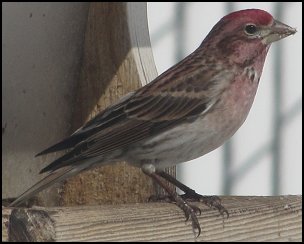
Still, I saw the first sign of spring in my backyard several days ago with the reappearance of the Cassin's finches - at least two pair, with the brightly colored males and boldly marked females both visiting the feeders and snacking on hulled sunflower seed. Theoretically, Cassin's finches are found in Utah year-round, but that has never been the case in my yard. They will visit for a few weeks to take advantage of the food and shelter I provide, but as the trees begin to embrace the warming season they will disappear to better nesting areas and more natural food sources.

Despite the season's delay, migrants are starting to appear - I've noticed a few yellow-rumped warblers flitting about the trees nearby, and the numbers of birds at my feeders are beginning to rise. Hopefully this pause in the season will be over soon, and I'll have more than the one rosy sign of spring my yard has thus far seen.


Wednesday, March 16, 2011

March Madness

Sometimes, birds aren't at all appreciative of the effort you make to provide a comfortable, safe, backyard habitat for them to enjoy. I have a heated bird bath that I've tried to keep meticulously filled and clean all winter, yet earlier this week the American robins that stopped by for a refreshing dip were far more interested in the scummy, filthy water that has accumulated on the base of our basketball hoop from random spring sprinkles and snow melt. Granted, the puddle on the basketball hoop is much shallower than the bird bath, but the mild depth of the bath has never deterred either bathers or drinkers.

Maybe these robins just wanted their own March Madness - mad for bathing, mad for spring to arrive and mad to look their best for the ladies. Soon enough the mating madness will take over (my Eurasian collared-doves are getting a head start), but for now I'll appreciate any and all visits the birds make to my backyard, even if my bird bath stays lonely.

Saturday, March 12, 2011

Good-Bye Juncos

The weather is warming, the snow is melted, and spring is most definitely advancing on northern Utah, so I was surprised last weekend to see a pair of foraging dark-eyed juncos near Skipper Bay in Provo. These birds are rare in my backyard but I see them quite regularly through the winter as I hit the wooded trails, but I don't recall seeing them quite so late in the past couple of years. It was a pleasure to see them, with the warm colors the lowering sun cast on their plumage were an ironic contrast to their preference for chillier climates.

Having watched their energetic foraging along the trail for a few minutes, I was fairly sure that would be my last sighting of these dark-eyed, light-billed beauties this winter, but this afternoon I was proven wrong. I heard the spring chorus of an eager male house finch looking for a mate from one of the trees near my backyard and when I looked for him, I saw a sprightly visitor bouncing around the same tree. A quick glance through the binns and I knew the juncos had come to say good-bye: they flitted through the trees for a few minutes before flying off.

See you next winter.

Wednesday, February 16, 2011

Butter-Butts Are Back

The first sign of spring flew through my yard this week - or more accurately, through my neighbor's yard to feed on the leftover apples - a butter-butt, or for the less colloquial, a yellow-rumped warbler. I noticed the bird hawking around the tree a bit and its behavior wasn't at all sparrow- or finch-like, which are my two most frequent visitors this time of year. A quick peek through the binoculars was all that was needed, however, to see the distinct warbler profile, yellow flank patch, dainty bill, and eye ring. A quick turn of a pose and I saw a flash of its bright rump as well, and there's no denying what bird it is.

What an exciting moment it was, to realize spring is on the way and perhaps closer than believed. Yellow-rumped warblers are the earliest migrating warblers in North America, and in some places they may overwinter. Admittedly, they don't stay through Utah's bitterly cold winters, so this bird's persistent appearance is a sure sign that the weather is warming.

There is another lesson here: just how valuable fruit trees are in the spring. If this particular golden delicious apple tree had been thoroughly harvested and stripped of its fruit to avoid the "hassle" of fallen apples over the winter, there would have been no food source for this early warbler to take advantage of. Throughout the long cold season, I've also seen American robins, European starlings, Eurasian collared-doves, and house finches taking advantage of the bounty to varying degrees. Certainly some birds prefer the fruit while others may just be giving it an idle sample or searching for insects on the fruit, but nonetheless it is a critical resource for many winter and early spring birds. My crabapple trees, still new to the landscaping, haven't been getting as much attention, but I anticipate that in the next few weeks they too will be fed upon by returning birds, and all are welcome at the buffet.

Thursday, April 1, 2010

Sandhills in Spring

Spring weather in Utah can be unpredictable, with a chilly start to a morning that leads to a warm day that leads to a fluffy snowstorm in the afternoon that finishes with a clear sunset and balmy breeze. On such days, one has to take advantage of birding whenever possible, and it is always possible to get lucky.

I got lucky last weekend, but it wouldn't seem so at first. We began our walk at one of the easternmost parks in Provo Canyon, beyond Bridal Veil Falls, but the partially cleared path was quickly obscured by avalanche debris. Not to worry, it was solid enough for sturdy footing, but along the entire way we only spotted a few mallards in the river reeds and quite a few song sparrows merrily singing. While that is pleasant, I'd been hoping for a few different birds, but no. The scenery was gorgeous, but the birds were absent.

Next, we drove down Center Street in Provo looking for a roost of turkey vultures I'd heard about, but either we missed the area or the birds were absent there as well. Strike two.

At the end of Center Street by Utah Lake, we turned toward Skipper Bay Trail. We were already down there, I reasoned, so we might as well investigate the recent sightings of the Harris's sparrow. Despite scrutinizing the area where the bird has been seen, however, I was only able to see European starlings, black billed magpies, American robins, and a lone killdeer. While this was an improvement on the paltry birding earlier in the morning, it still wasn't so exciting as I'd hoped.

As luck would have it, we drove a different way home, through back roads and recent developments interspersed with as yet unworked agricultural fields. Around a curve in the least likely of places, there was my treasure of the day: a pair of beautiful sandhill cranes, the first I've seen this year. They were quite close to the road and unperturbed by my presence, and I watched them forage for several minutes while they obliquely watched me in return.

Some birding days are better than others, but it pays well not to give up. Try a new location, look for different birds, and enjoy all those you see, and you'll have a very bird-iful spring. Happy birding!

Saturday, March 27, 2010

Swans and Songs

What a difference a week can make for birding. Two weeks ago, I participated in Utah's annual Tundra Swan Day with a birdwalk to see these lovely birds. The trip didn't quite turn out as planned - Utah's unpredictable spring weather intervened, and we spend quite some time on a ridge overlooking what we knew to be a flock of thousands of tundra swans, but seeing white birds through a white snowstorm floating on gray water under a gray sky doesn't lend itself to magnificent views. Fortunately, our leader - Bill Fenimore - kindly took us to another property where we were able to get much better views. Other sightings on that leg of the trip included dozens of bald eagles, different gulls, and a very cooperative horned lark that became the latest bird added to my ever-growing life list, bringing the total to 176.

Just a week later, the climate couldn't be more different. I went again to the Skipper Bay Trail near Utah Lake - one of my new favorite birding spots - and had the most enchanting encounter with a gregarious flock of red-winged blackbirds, watched flocks of foraging robins, laughed at agitated killdeer, and had a wonderful solo performance by a cooperative song sparrow. Rather than a snowstorm, the temperatures that day were mild and the weather pleasant; a truly beautiful weekend for the first weekend of spring.

So what will the next few weekends bring? Hopefully more opportunities for birding and more lifers for an eager birder!

If you're going into the field soon, these spring birding tips can help you make the most of it!

Sunday, March 7, 2010

Suddenly Snowy

For the past few days, spring seems to have been lurking just over the mountains, waiting to descend upon the valley in a rush of warm winds, green grass, and birdsong. That was not to be earlier this week, however, when four inches of heavy, wet snow fell overnight, burying feeders and shattering branches all over the neighborhood.

In the backyard, the nets I keep beneath Nyjer feeders to catch spilled seed quickly became floating snowdrifts, but that was not to stop industrious house finches, American goldfinches and lesser goldfinches from nibbling away. Instead of needing to dangle on the feeders, they simply stood on the snow to eat their fill. In the front yard, the lee side of the feeders was protected from most of the snow accumulation and thus became a popular dining spot, though when birds landed in the nearby aspens they were nearly buried among the branch drifts.

Just as quickly as it came, it was gone. Even that same day the snow melted away from the feeders (much to the delight of more hungry birds), and now it is gone from the grass as well. That hasn't stopped my life list from getting a bit snowier, however - just today I had the most marvelous walk along the Skipper Bay Trail near Utah Lake, and in two hours of birding a mere 1.25 mile stretch I spotted 26 species, including a common raven, plenty of black-billed magpies, several northern flickers, a flock of white-crowned sparrows, two playful northern harriers, and thousands of ducks: American wigeon, northern pintails, cinnamon teals, and green-winged teals, not to mention dozens of mallards. A tremendous flock of red-winged blackbirds also yielded a pair or two of Brewer's blackbirds, and song sparrows, house finches, and black-capped chickadees were also in evidence, along with one industrious downy woodpecker.

The highlight of the walk, however, were the two snow geese feeding among a flock of Canada geese. Their brilliant white plumage, thick bills and black wingtips were beautiful to see, all the more so because they are the newest addition to my life list.

The signs of spring aren't in whether the snow falls or melts, but in the behaviors of the birds. Just two days ago I was snowed under, but this morning I was surrounded by birdsong. Despite sometimes questionable weather, there is no doubt that spring is one the way when you begin to see new species migrating and birds pairing off to prepare their nests. Snowy or not, it's a great season to be birding!

Tuesday, April 22, 2008

Golden Spring

Spring is golden, and so are the most recent visitors to the feeders: a pair of lesser goldfinches. While their spring coloring can be just as vibrant as the more familiar American goldfinch, their markings are a bit more blurred though no less distinctive. The surprise I've found is that they are happy to be guests at the platform feeder as well as the perching finch feeders.

When I blend seed, I typically use one part wild bird mix (the doves prefer most of those seeds), four parts black oil sunflower seeds, and one-half part niger or thistle seed, since the house finches are wildly attracted to the perching tube feeders despite the fact that they are just a shade too large for comfortable perching. Much to my astonishment, the lesser goldfinches have enjoyed probing on the platform feeder to find the niger seed that spills there.

You can see the size difference between the two species quite clearly, though both have voracious appetites and the feeders empty rapidly when they share the honors of dining at the backyard buffet. On the left is a female house finch, precariously balanced, and on the right is a male lesser goldfinch, eagerly enjoying the same treat. While the goldfinches can typically perch for long periods of time and nibble continuously, the house finches tend to perch briefly when they can maintain a few seconds of balance, snatch a bite or two, before fluttering to regain their position. They can be quite territorial and aggressive when feeding at the perches, particularly when larger numbers of birds vie for the same choice tidbits, though having added multiple tube feeders this year seems to have diminished the competition. Perhaps adding niger seed to the hopper mix has also helped foster cooperation between the species and bring everyone peacefully to the table.

Sunday, April 13, 2008

Endangered Species

This blog will be an endangered species for some time to come, as other life matters intrude on my love of backyard birding. Nonetheless, I still plan on progressing with the work to create a bird sanctuary, however slowly.

I have continued to build a brush pile to provide interim shelter and safety to winged visitors, gleaning a wide variety of sticks and scraps from other people's spring prunings. Thus far, some birds have visited the brush pile, even seeking it out to hunt for insects. The other landscaping work, however, is seeing less progress as the estimates came in too far above budget to be accepted comfortably. Instead, we plan on doing much of the preliminary work ourselves in preparation for professional labor in about a year. This will also give us more time to plan the layout for the feeder island and specific plantings we are interested in, and it's better to take it slow and do it properly than to rush and be unhappy.

As spring progresses, more species have reappeared. The mourning doves have returned, and the first California quail was pecking about on the patio recently, eagerly searching for scattered seeds. The quail are most amusing to watch, with their butterball physique, skittish mannerisms, and perfectly straight running tracks when spooked. There are quite a few quail in the neighborhood, and hopefully more of them will be visiting soon. They enjoy scratching in the mulch for different seeds, and I'm happy to spread more to give them their favorite treats. The western scrub jays are still absent, but I have spotted them out in the neighborhood recently and in another week or two I'll put out the peanuts in the shell they love so much to hoard (I found four recently while working in the flower beds), so hopefully they'll be happy to return as well.

It is ironic that just as there is more to write about with regards to backyard birding, there is less time to craft the words. Much better to be out and enjoying the visitors while making their stay more pleasant, but updates will come when they are able. We all need to spread our wings, shake our feathers from the winter laziness, and take flight into spring!

Friday, March 21, 2008

Spring Pause

Today may be the first day of spring, though you wouldn't know it by the weather or the landscape -- chilly temperatures and no discernable growth still gives today more of a wintery feel. Nonetheless, the birds know its spring and they broadcast it loudly -- mating songs and other tweets of joy are most discernable between 5:30 and 7 a.m. and their sweet notes can be heard for tremendous distances for such tiny lungs.

Progress is slowly being made on the landscaping. We've gotten bids on the work and plan to make final arrangements within the next week or two, and after that the work should progress quickly. Within six weeks I hope to have the project finished, or at least this phase. Likely we won't be planting much this year, but we'll be prepping the soil with composting material so it can be richer and more nourishing for plants next spring. Since much of the new bed has been continually exposed to the elements, the soil isn't as healthy as young plants would like.

This early in the season, the only visitors have still been sparrows, house finches, and Eurasian collared doves. I have spotted California quail and Western scrub jays in the nearby park, however, which bodes well for them visiting the backyard again this summer. As the days warm other species should begin to reappear, and hopefully they'll be interested enough in the changes to the yard to stop and investigate. I've switched to a richer birdseed mix -- more than five parts black oil sunflower seeds -- and with the birds who have already found it, it's popular for breakfast, lunch, and dinner.

I just wish breakfast weren't quite so early some mornings.

Monday, March 10, 2008

A Rainbow of Finches

Spring is finally edging into Utah Valley and with its return come the house finches, always the first and most ravenous guests at my backyard feeders. As of yet they're still timid, but the male finches are showing their dramatic mating plumage.

Standard coloration is a red forehead and neck with eye streaks and a wash onto the chest, but I've had both orange and yellow color variants visit in the past. Thus far this season only the standard red males and one yellow male have made appearances at the feeder, accompanied of course by the more camouflaged buff females.

There is no definitive explanation for the color variations; some ornithologists speculate that it may be due to regional separations, while others favor the idea of a dietary influence or even poor nutrition. Neither explanation seems suitable to me: both colors share the same feed and territory regularly in my backyard. My theory is that it is no more complex than the genetic hair color variations among humans: some people have red hair, others blonde. Regardless of the scientific explanation, I find the different colors to be a beautiful palette to enjoy as spring strengthens.