Friday, June 10, 2011

Lessons From Ducks

There are many things to be learned from backyard birds, and I'm fortunate to have mallards that regularly visit my platform and tray feeders - they've taught me a lot. The past few weeks have been some of the most stressful, most hectic of my life, but you can always learn from ducks...


  • Take time to savor the moment, whether it is a warm patch of grass and sun or a cool dip in a nearby pond.

  • Try new foods; if the cracked corn isn't available, you might just discover that you like millet too.

  • Be willing to cooperate and watch over one another, taking turns taking care of one another.

  • Learn to trust the ones who help you and offer you a treat, even if you still need to be cautious.

  • Say thank you and you'll reap the rewards of a stronger, more fulfilling relationship.
I've observed all of these behaviors in my mallards, both between the mated pair and Sheila's (the hen) interaction with me. Such simple things, but so much to learn from all the birds in our lives.

May your lessons be as meaningful, and help you out when your life needs it.

Friday, May 20, 2011

Millet Mania

It has always interested me how certain birds have very precise feeding preferences; they will only visit a certain type of feeder, will sort through a mixed seed to find their favorites, and may even eat in a very particular way. This is never so apparent at my backyard feeders than when the lazuli buntings come to visit.

These beautiful spring birds are mad for millet - they will swarm over my platform feeder frantically feeding, and they quickly discover other feeders offering millet or mixed seed they can pillage. They staunchly ignore other feeders, however, even with the choicy hulled sunflower seeds or more expensive Nyjer.

I'm thrilled that the lazulis have returned this spring; I've had a dozen or more males feeding at once, with a smaller but no less voracious number of females. Fortunately, my platform feeder is still housed beneath the patio table for shelter from the spring rains, but even chilly, unseasonable weather hasn't deterred their appetites - I'm adding another heap of millet to the feeder every couple of days. I know they won't stay around for long and will probably leave for more elevated nesting areas in another couple of weeks, but while they're here I'm happy to host a millet-heavy buffet.

Wednesday, May 4, 2011

Duck Drama

This spring has been a dramatic one for the resident mallards in our neighbor's pond. Each year a pair scouts the pond in early nesting season, and invariably we see the ducklings for a day or two before they graduate to wilder surroundings than a cultivated backyard pond. This year, however, two drakes have been contending for the affections of one female, and one of the drakes has been the clear victor - that is, he has retained his tail feathers while the other has been ceremoniously unmanned. For several days he sulked around our patio (not too wounded to ignore the cracked corn), and even now he occasionally flits over to the pond until he is chased away by the mated mallard. The female, in the meantime, ignores them both for the most part. There has been a second female visiting on occasion and while the two gals will get together for a good gossip, only one stays nearby.

Then, just a few days ago, the ducklings arrived. Always adorable, these small balls of fluff were not at all tentative in trying out the water this year, and when they tired they curled up under mom's feathers to stay warm and snuggle. Their early lives were not without drama as well, however, as one of the drakes started to chase the brooding female all around the pond. She was frantic - unwilling to fly and leave her babies, she kept circling around her brood even while the male was quite literally on her tail. Fortunately, our neighbor intervened and chased away the drake several times, and eventually he got the idea that he wasn't welcome for the time being.

Now the ducklings have moved on, but one adult pair is still visiting occasionally, including raiding our cracked corn dishes - to which they are most welcome. My best thought is that it is likely the second female and the earlier rejected drake - now graciously regrowing his tail feathers, which are coming in but notably shorter than average. Perhaps later this spring we'll have visits from another young brood, but hopefully without as much drama.

Sunday, April 24, 2011

Looking for Loons in All the Wrong Places

It's getting harder and harder to easily see new birds in Utah as my life list keeps growing, but earlier this month I had the best of luck looking for loons on the mountain reservoirs. While most spring birds have not made extended appearances yet, the common loons are most gracious as they pass through the mountain west, and they readily rest on the deep, chilled reservoirs before continuing their flights north.

I have always wanted to see a loon and add these unique and distinctive birds to my life list, and it was far easier than I'd imagined. We'd no sooner driven to the westernmost edge of the Deer Creek Reservoir when I spied a distinctive head and low-riding back in the water, and we quickly turned to park alongside the edge and enjoy views as the bird floated serenely on the choppy waves, occasionally dipping its face into the water to spy fish before diving to hunt.

Further up the canyon and deeper into the reservoir, we saw even more loons, all placidly enjoying a swim. Their checkered plumage, banded necks, and rich, dark heads are unmistakable, and I could have looked at them all day. In total, at least two dozen of the birds were widely spaced on the water, keeping well away from early spring fishers.

The most interesting thing is that no field guide mentions that common loons can be commonly seen in Utah. Granted, the timing has to be perfect - they only pass through this area for a short time on migration, and one has to know where to look to get these privileged views. For several years now, I've tried loon-spotting on the wrong days or in the wrong areas, always to go home disappointed.

Not this year; the loons were beautiful, my life list is one longer, and spring is getting off to a great start.


Sunday, April 17, 2011

A First Sign of Spring

Despite it now being mid-April, winter has been protracted this year and spring isn't as advanced as you would expect. The weather is warming and flowers are beginning to bloom, however, but most trees are holding tight to their winter hibernation, at least for the moment.

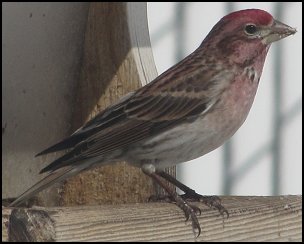
Still, I saw the first sign of spring in my backyard several days ago with the reappearance of the Cassin's finches - at least two pair, with the brightly colored males and boldly marked females both visiting the feeders and snacking on hulled sunflower seed. Theoretically, Cassin's finches are found in Utah year-round, but that has never been the case in my yard. They will visit for a few weeks to take advantage of the food and shelter I provide, but as the trees begin to embrace the warming season they will disappear to better nesting areas and more natural food sources.

Despite the season's delay, migrants are starting to appear - I've noticed a few yellow-rumped warblers flitting about the trees nearby, and the numbers of birds at my feeders are beginning to rise. Hopefully this pause in the season will be over soon, and I'll have more than the one rosy sign of spring my yard has thus far seen.


Sunday, March 27, 2011

Rock On!

Having a very urban, relatively bland backyard can make backyard birding a challenge, but I was thrilled to add a new yard bird to my list this weekend: a rock pigeon. The irony is that these birds are often one of the most common in urban areas, but they've never before graced my feeders. Two of the beauties - a matching pair of classically plumaged birds with iridescent necks - found my feeders and enjoyed foraging beneath them, hunting for seeds and insects that may have spilled.

A lot of birders don't appreciate the rock pigeon for what it is: a remarkably adaptable, unflappable bird that has survived and thrived in some of the widest ranging habitats and most variable conditions on the planet. From their native European cliff nesting grounds to urban habitats around the world, rock pigeons are the ultimate success story in avian fitness. Granted, I'm privileged in that I've only had a single pair of these birds at my feeders rather than a ravenous flock, but even in areas where I am surrounded by these birds they remain among my favorites.

I'm also thrilled for their visit for another reason; their appearance at my feeders completes the trio of common dove species to visit my yard: Eurasian collared-doves, mourning doves, and rock pigeons. These three species are found throughout Utah, and while several other species do make cameo appearances in the state, these three are the only ones likely in my area and certainly at my feeders, where all three are most welcome.

It was gratifying, too, to have the opportunity to compare the rock pigeon's behavior to that of my more familiar doves. It is curious that they fall between the magnanimous, laid back personalities of the mourning doves and the highly skittish, always-on-alert personalities of the Eurasian collared-doves. Whey they were startled by noises and unusual movements, rather than flushing immediately as the collared-doves are prone to do, they froze, evaluated the situation, then resumed foraging when they saw no further threat.

They didn't stay long, but I do hope they'll return. Rock on, rock pigeons.

Sunday, March 20, 2011

Diamond Duck

Spring still hasn't quite arrived here in my part of Utah, but it is getting closer. Ice has receded on many ponds and shores, and for a short visit today we strolled along one of those shores in American Fork, at a pond where mallards and their manky relatives stay the winter. In a dirty little secret of mine, we took along a very small hunk of bread to feed the flock - just a rare treat, and never so much to foul the water - and it was well received.

One of the flock, a white domestic duck that appeared to have clipped wings but is no less brave and curious for his affliction, was bold enough to nibble from - and on - my fingertips for a few scraps. As I was feeding him, it was to my astonishment that he kept trying to take bread when I had no more to give at that moment, until I realized he wasn't actually nipping at my fingertips, but rather at my left ring finger and the diamond that glitters there. He was quite insistent even after I'd moved my finger away - a duck with very good taste.

Two notes about such visits to a pond, whether you're in Utah or anywhere your pond may rest - never feed bread frequently to the birds, as it offers no more nutrition to them than a candy bar would to you, and too much bread is unhealthy and unwise. Second, always keep an eye open for fishing line that could strangle and injure waterfowl and other birds; we collected quite the clump today. For a quick treat and a quick rescue from what could have been, it was a very lovely lazy Sunday walk.

Wednesday, March 16, 2011

March Madness

Sometimes, birds aren't at all appreciative of the effort you make to provide a comfortable, safe, backyard habitat for them to enjoy. I have a heated bird bath that I've tried to keep meticulously filled and clean all winter, yet earlier this week the American robins that stopped by for a refreshing dip were far more interested in the scummy, filthy water that has accumulated on the base of our basketball hoop from random spring sprinkles and snow melt. Granted, the puddle on the basketball hoop is much shallower than the bird bath, but the mild depth of the bath has never deterred either bathers or drinkers.

Maybe these robins just wanted their own March Madness - mad for bathing, mad for spring to arrive and mad to look their best for the ladies. Soon enough the mating madness will take over (my Eurasian collared-doves are getting a head start), but for now I'll appreciate any and all visits the birds make to my backyard, even if my bird bath stays lonely.