Showing posts with label Eurasian Collared Doves. Show all posts

Monday, January 3, 2011

Got Doves?

I may not have great bird diversity in my backyard during the wicked Utah winter, but there's no denying that I have great numbers of birds. That is never more obvious than when the flock of Eurasian collared-doves comes to feed. My backyard doves, in particular, never seem to have learned that doves are typically ground feeding birds, and instead they've learned how to attack the hopper feeder from my flocks of sparrows and finches. They crowd one another out, land on one another, and occasionally nip one another in order to get at the hulled sunflower I feed. Some are more patient, however, and will stake out positions on top of the feeder, on the nearby stump, or in the adjacent hawthorn tree to wait their turns (or just because they won't fit at the feeding ledge). I've had as many as a dozen or more at once, and these are not small doves by any means.

I never tire of watching these birds, and Eurasian collared-doves hold a special place for me. I had never seen one before moving to Utah, and the first day I saw one on our patio I dismissed it at a quick glance, believing it to be a mourning dove. Something about it caught my eye, however, and I looked closer - it didn't have the spotty wings of a mourning dove, it was much too big, and no mourning dove had that ring on the back of the neck. After a quick consultation with my favorite field guide (Kaufman Field Guide to Birds of North America), I had a new lifer on my list, and it's been a favorite bird of mine ever since.

Over the years, I've marveled at these doves' personalities - they tend to be more skittish and nervous than mourning doves and they're frantic eaters, which stems from that nervousness and a wariness of any potential predators. Their harsh coos remind me of owls, and like all birds, they are distinct individuals. I've had one that would smack its comrades with a wing if they got too close when feeding, and another one is a definite nipper. I've even had one visit that was partially leucistic, with patches of much paler feathers and an overall lighter coloration that made it distinctive.

A lot of backyard birders may feel that doves - particularly ones with such voracious appetites - are less than welcome at their feeders, but these beautiful birds will always be welcome at mine.

Monday, November 15, 2010

Welcome Home, Friend

Over the weekend I was thrilled to have a familiar bundle of feathers once again at my feeders. All summer I had dozens of mourning doves - feeding, sunning, stretching, preening, and trying to get laid - all through the yard, but they've been sadly absent for the past few weeks. Instead, the Eurasian collared-doves have taken over, but I've missed the gentle mourning doves.

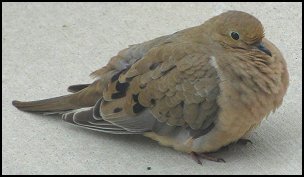
When I went to take out the trash on Sunday, however, a tawny gray bundle of feathers moved about in the flower bed near my weeping tree, and slowly a solitary mourning dove walked onto the patio, pecking here and there at a loose seed or bit of grit. Though I've been used to these doves and they are larger than most of my backyard birds, I was surprised to see how small they look in comparison to the Eurasian collared-doves to which I've become accustomed.

It was a cold day for this dove, however, and it stayed on the concrete, puffed up and still, keeping well insulated against the bitter breezes, though it was beautiful to watch with its fawn-colored plumage and pink breast wash. It stayed for awhile, and was eventually joined by another mourning dove who wasn't so bold as to come onto the patio. Still, they are welcome to stay, and the feeders are refilled this morning for whomever may be interested in a meal or a snack. Welcome home, friend!

Friday, March 27, 2009

Backyard Bonanza

Today was quite the day for visitors to the backyard, despite the fact that I refused to refill the six now empty feeders only one day after they were all bursting with seed. (For small birds, pine siskins are absolutely voracious.) Nonetheless, the bright but chilly day, the spilled seed on the ground, the dregs in the mesh nyger sock, and the heated birdbath attracted quite the menagerie:

  • Cedar Waxwings
  • Pine Siskins
  • Lesser Goldfinches
  • American Goldfinches
  • American Robins
  • Mourning Doves
  • Eurasian Collared Doves
  • House Finches
  • Cassin's Finches
Despite the fact that the ducks did not come calling today, I don't believe I've had a birdier day in the backyard. And there are amazing observations that accompany such a flock...
  • You never know when, nor for how long, a unique visitor will appear. I happened to be working at the dining table this morning, and while doing so I'd moved my chair to easily see the feeders and watch the fun. I was astonished to notice a small flock of cedar waxwings alight in the trees bordering our northern fence, and even more astonished when they came into the yard to visit the birdbath. They were only there for a few minutes, and if I'd been working in my office on the other side of the house I'd have been none the wiser.

  • Water is an irresistible attractor. Every one of the bird species that visited today stopped for a sip from the concrete birdbath, but the cedar waxwings and American robins weren't the least bit interested in the available seed. If you truly want to attract the widest variety of species to your yard, you definitely need to have water available. And this was just from a still birdbath (and one that was none too clean at the time) - I can hardly wait to see what happens in a couple of weeks when the new fountain is installed.


  • The smaller the bird, the bigger the attitude. The pine siskins are some of the smallest to visit my feeding areas, yet they are the most vicious and temperamental of the entire mixed flock. They will snap at other birds, including other siskins, as well as beat them with their wings and engage in spectacular aerial dogfights (birdfights?) complete with an unrelenting barrage of buzzes, chirps, and chatters. The result? A momentary monopoly on the feeder - almost invariably the nyger sock - until another siskin decides to take on the challenge for feeder dominance.

The most important thing to learn from so many visitors, however, is that there is always something new to observe and you can always care for every bird. Every day I'm amazed at the birds that will make eye contact with me, chirp at me, and even buzz me while I'm refilling the feeders or scrubbing the birdbath. While some may think they're simply being territorial and reacting to a perceived menace, I believe they do recognize me and our fondness is - at least at times - mutual.

That, or I simply need to refill the birdfeeders more often. Happy birding!

Wednesday, February 27, 2008

Winter Visitors

With realistically no cover in the yard, coupled with the heavy snowfall we've had this season that covers feeders and conceals seed, avian visitors have been few and far between during the winter months. In the past few weeks, however, a pair of Eurasian collared doves have made regular visits to the feeder, even more frequently now that the snow is nearly melted and the seed is more accessible.

This pair is extremely camera shy; it took me several days to sneak in a photograph that showed both of them enjoying a treat. Their markings are very distinctive, and their recurring visits to my backyard demonstrate the mobility of the species, since it was originally introduced east of the Rocky Mountains but has now increased population sizes to span more of the continent.

They're delightful to watch. One of the pair will generally perch on the roof or one of the two small trees nearby to serve as guard while the other begins to feed, though the temptation is overwhelming and very soon both doves will be on the feeder platform (they are too large to comfortably feed from the hopper perches). If they spot an observer through the window, they flit off immediately and may not return for several minutes, if at all.

They are most welcome. They eat the larger seeds in the mix that are disdained by smaller birds, and so they help keep both the feeder and the patio clean. In the summer there may be another pair that visits, but in these colder weeks it is only the one pair that continues to drop by for dinner, and I'm pleased to be their hostess.