Showing posts with label Mourning Doves. Show all posts

Wednesday, December 1, 2010

Death of a Dove

The mourning doves I enjoy so much have been having a rough time since they returned to the yard just a couple of weeks ago. First, the weather changed drastically from hot to cold very quickly, and then, just another day or two later, the Cooper's hawk made a meal of one.

I always do enjoy seeing backyard hawks, despite the fact that when I do it often means my backyard flock has suffered a loss. The most recent casualty was just after the snow began to fall and my sparrows and finches were huddled in their brush pile; the mourning doves, however, do not frequent the shelter that profile provides, and the Cooper's hawk found that weakness. The hawk attacked and landed on the dove, but since the dove is so large and the hawk still young, it wasn't a fatal blow. The hawk was prepared for that, however, and it sunk its talons into the dove to wait. As the dove struggled, the hawk massaged its talons gently, driving them deeper into the dove until the struggle ended.

Staying out in the open for that long as the prey expires, however, is stressful to the hawk. It kept looking around, watching carefully for raiders or other potential predators. As soon as it could - as soon as its meal was less resistant - it flew off to eat in peace in a more secluded, secure place. The evidence of the dove's struggle was left behind in a bright splash of blood on the concrete curbing and a few scattered feathers, all that remained of one of the mourning doves I've been so happy to welcome back to the yard.

While this story has a tragic ending for one dove, I'm also pleased that it wasn't the only dove to have returned recently. While the flock may now be one smaller, I'm still happy to have the company of at least three more mourning doves, feeding and roosting in their patient way. Time will tell if the hawk is even more patient.

Sunday, November 28, 2010

Hot and Cold Doves

At this time of year, the weather in Utah is ultimately unpredictable, as my mourning doves have discovered in the last week. At first, it was wonderful lazy dove weather - perfect for sunning and stretching out in the toasty mulch beds. The doves will do that for hours, shifting position now and then as the sun shifts in the sky, but always just calmly enjoying its warm rays. Occasionally there will be a tail stretch, a wing stretch, or a feather ruffle, but for the most part it is a lazy and relaxing activity.

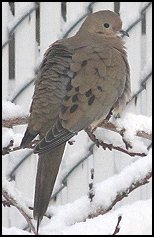
Overnight, however, the weather can change, and those same mulch beds are blanketed with snow. The mourning doves seem to appreciate this less, as they will be forced to perch and huddle on branches or the fence as the snow builds up around them. Still, they are stoic about it, and even a temperature drop or sudden snowfall doesn't faze their gentle countenance.

It is fanciful to think that perhaps the doves - or any sunning birds - store up heat to use in the winter, but they do have many ways to keep warm. Their feathers are better insulation than anything we can devise, and by offering good food - my hopper feeders are filled with hulled sunflower hearts - we can help them have enough energy to maintain a strong body heat for survival in the coldest weather. Providing liquid water is also essential, and I'm happy that my heated bird bath is out and available for everyone to sip. Shelter will help the birds keep warm, and my pine brush pile is a welcome haven for many finches and sparrows, though the doves rather disdain its prickly cover.

This time of year can be hard on the birds and mortality rises, but if you provide good food, water, and shelter, you can help your backyard birds survive. What's more, you'll be able to enjoy hot and cold birds year round, always marveling at their adaptations in any season.

Monday, November 15, 2010

Welcome Home, Friend

Over the weekend I was thrilled to have a familiar bundle of feathers once again at my feeders. All summer I had dozens of mourning doves - feeding, sunning, stretching, preening, and trying to get laid - all through the yard, but they've been sadly absent for the past few weeks. Instead, the Eurasian collared-doves have taken over, but I've missed the gentle mourning doves.

When I went to take out the trash on Sunday, however, a tawny gray bundle of feathers moved about in the flower bed near my weeping tree, and slowly a solitary mourning dove walked onto the patio, pecking here and there at a loose seed or bit of grit. Though I've been used to these doves and they are larger than most of my backyard birds, I was surprised to see how small they look in comparison to the Eurasian collared-doves to which I've become accustomed.

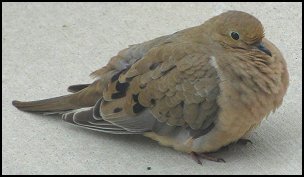
It was a cold day for this dove, however, and it stayed on the concrete, puffed up and still, keeping well insulated against the bitter breezes, though it was beautiful to watch with its fawn-colored plumage and pink breast wash. It stayed for awhile, and was eventually joined by another mourning dove who wasn't so bold as to come onto the patio. Still, they are welcome to stay, and the feeders are refilled this morning for whomever may be interested in a meal or a snack. Welcome home, friend!

Monday, September 27, 2010

Survivor

It can be brutal to be a bird, especially to be a nervous mourning dove in a backyard regularly visited by Cooper's hawks. Such was the case several weeks ago, when I looked out my patio doors and saw what appeared to be the remnants of another hawk hunt - a pile of feathers pressed into the grass. This is a relatively common occurence in my yard, and typically one or two birds fall prey to my hawks every week. Walking closer, however, I realized this time it wasn't simply remnants - the entire bird was still there, as still as death, or so I thought. Coming to within five feet of the bird proved it wasn't death after all, as the bird burst from the battered hollow and flew a few feet away.

Curious about the dove I followed, watching its behavior. It clearly didn't want to fly, but nor did it want to venture far. While it was wary of me it wasn't exhibiting the fear most of my mourning doves do when I step outside, but instead it wandered onto the concrete driveway and it wasn't until the dove paused by the garage door that I realized just how close to death this bird had come. Blood was flowing thickly down its leg, obviously draining from a chest wound where the hawk had begun its interrupted meal. Further examination showed just how many feathers the bird had lost around its neck and chest, giving it a mangled, battered appearance.

I had a choice of what to do; I could have traumatized the bird further by capturing it, keeping it confined until I was able to get it to a rehabilitator several hours later, or I could let it be. Given that it was still capable of flight, was breathing and walking well, and knew that the best thing to do was to keep still and slow, I let it be. I kept checking it throughout the day, and it moved locations, seeking shade and shelter which I was happy to give it. When it roosted under the lilac in the evening, I left a dish of water a few inches away and sprinkled some seed nearby for a meal.

Never having known a hawk to pull down its prey but abandon the meal when the bird was so gravely injured, I reexamined the scene of the attack. Sure enough, lightly tossed on the grass I found a clue - one tawny feather obviously from the chest of the hawk itself. This dove had fought back, forcing the hawk to abandon its meal if for nothing more than aggravation - dinner shouldn't bite.

Sad to say, the dove did not survive the night; I found it the next morning still beneath the lilac bush, though it had obviously fed and drank as best it could during the night. One might question, then, why I consider this mourning dove a survivor when it did not, in fact, survive. It may have died, but it was never prey. It might not have lived, but it didn't die under a hawk's talons. If that's not surviving when you're a bird in a world filled with predators, what is?

Friday, March 27, 2009

Backyard Bonanza

Today was quite the day for visitors to the backyard, despite the fact that I refused to refill the six now empty feeders only one day after they were all bursting with seed. (For small birds, pine siskins are absolutely voracious.) Nonetheless, the bright but chilly day, the spilled seed on the ground, the dregs in the mesh nyger sock, and the heated birdbath attracted quite the menagerie:

  • Cedar Waxwings
  • Pine Siskins
  • Lesser Goldfinches
  • American Goldfinches
  • American Robins
  • Mourning Doves
  • Eurasian Collared Doves
  • House Finches
  • Cassin's Finches
Despite the fact that the ducks did not come calling today, I don't believe I've had a birdier day in the backyard. And there are amazing observations that accompany such a flock...
  • You never know when, nor for how long, a unique visitor will appear. I happened to be working at the dining table this morning, and while doing so I'd moved my chair to easily see the feeders and watch the fun. I was astonished to notice a small flock of cedar waxwings alight in the trees bordering our northern fence, and even more astonished when they came into the yard to visit the birdbath. They were only there for a few minutes, and if I'd been working in my office on the other side of the house I'd have been none the wiser.

  • Water is an irresistible attractor. Every one of the bird species that visited today stopped for a sip from the concrete birdbath, but the cedar waxwings and American robins weren't the least bit interested in the available seed. If you truly want to attract the widest variety of species to your yard, you definitely need to have water available. And this was just from a still birdbath (and one that was none too clean at the time) - I can hardly wait to see what happens in a couple of weeks when the new fountain is installed.


  • The smaller the bird, the bigger the attitude. The pine siskins are some of the smallest to visit my feeding areas, yet they are the most vicious and temperamental of the entire mixed flock. They will snap at other birds, including other siskins, as well as beat them with their wings and engage in spectacular aerial dogfights (birdfights?) complete with an unrelenting barrage of buzzes, chirps, and chatters. The result? A momentary monopoly on the feeder - almost invariably the nyger sock - until another siskin decides to take on the challenge for feeder dominance.

The most important thing to learn from so many visitors, however, is that there is always something new to observe and you can always care for every bird. Every day I'm amazed at the birds that will make eye contact with me, chirp at me, and even buzz me while I'm refilling the feeders or scrubbing the birdbath. While some may think they're simply being territorial and reacting to a perceived menace, I believe they do recognize me and our fondness is - at least at times - mutual.

That, or I simply need to refill the birdfeeders more often. Happy birding!