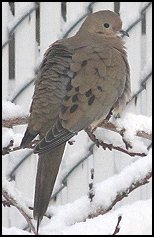
If you haven't heard, February is National Bird Feeding Month, and this year the birds need those extra tasty tidbits more than ever. The extreme snowfall over much of the country and even the bitter cold here in Utah make it harder for birds to find food just at a time they need more calories to maintain enough body heat to survive.Tuesday, February 1, 2011
National Bird Feeding Month
If you haven't heard, February is National Bird Feeding Month, and this year the birds need those extra tasty tidbits more than ever. The extreme snowfall over much of the country and even the bitter cold here in Utah make it harder for birds to find food just at a time they need more calories to maintain enough body heat to survive.Friday, January 21, 2011
Winter Sips
A winter wonderland may be filled with frozen water, but it's liquid water that birds crave. By providing water in your backyard via a heated bird bath all winter long, you'll see a wide range of thirsty birds visiting the bar for a quick drink.I love my heated bird bath - a very simple plastic basin with a concealed heating element (to prevent shorts and increase the lifespan of the heater) mounted in a plain metal frame. The house finches, lesser goldfinches, and American goldfinches all enjoy simple sips, but it is the house sparrows that truly enjoy the bath - in every way. More than once this winter I've spied my sparrows happily splishing and splashing, even on the chilliest of days. Many backyard birders worry that bathing birds might freeze in winter, but in fact they're quite well insulated and moderately wet feathers are not harmful on most days. The birds themselves don't tend to bathe in the most severe cold, and after a bath they often sunbathe or otherwise dry themselves off and warm up.
Even in winter, never forget to clean your bird baths and keep them freshly filled. This is especially important with heated baths, since a dry bath can cause the heating element to malfunction. I need to remember to refill mine more frequently, but whenever I see the birds balancing nearly headfirst for a quick sip, it's a great reminder!
Saturday, January 8, 2011
Pining for Winter
Anyone who might doubt the need for evergreen trees in a winter landscape as part of a bird habitat need only to watch my trees on any chilly day. My house sparrows flit back and forth from the feeders to their favorite winter perches, which include a dwarf mugo and two Colorado blue spruces, and at times it can look like the trees are strung with feathered ornaments. On a stormy day, they will duck deeper into the branches, and a whole flock of small birds may be sheltering in quite a small tree.Monday, January 3, 2011
Got Doves?
I never tire of watching these birds, and Eurasian collared-doves hold a special place for me. I had never seen one before moving to Utah, and the first day I saw one on our patio I dismissed it at a quick glance, believing it to be a mourning dove. Something about it caught my eye, however, and I looked closer - it didn't have the spotty wings of a mourning dove, it was much too big, and no mourning dove had that ring on the back of the neck. After a quick consultation with my favorite field guide (Kaufman Field Guide to Birds of North America), I had a new lifer on my list, and it's been a favorite bird of mine ever since.Sunday, November 28, 2010
Hot and Cold Doves
At this time of year, the weather in Utah is ultimately unpredictable, as my mourning doves have discovered in the last week. At first, it was wonderful lazy dove weather - perfect for sunning and stretching out in the toasty mulch beds. The doves will do that for hours, shifting position now and then as the sun shifts in the sky, but always just calmly enjoying its warm rays. Occasionally there will be a tail stretch, a wing stretch, or a feather ruffle, but for the most part it is a lazy and relaxing activity.
It is fanciful to think that perhaps the doves - or any sunning birds - store up heat to use in the winter, but they do have many ways to keep warm. Their feathers are better insulation than anything we can devise, and by offering good food - my hopper feeders are filled with hulled sunflower hearts - we can help them have enough energy to maintain a strong body heat for survival in the coldest weather. Providing liquid water is also essential, and I'm happy that my heated bird bath is out and available for everyone to sip. Shelter will help the birds keep warm, and my pine brush pile is a welcome haven for many finches and sparrows, though the doves rather disdain its prickly cover.Monday, October 25, 2010
Snow, Celebrations, and Stocking Up
The celebration was a good one, as Bill always hosts fine events. Several organizations brought live birds, and I got the most hypnotic looks from a northern saw-whet owl. I've never seen a bird blink so slowly, and I could stare into those eyes for days. Also in attendance were a great horned owl and several diurnal raptors. There were door prizes, refreshments, and as always, fantastic merchandise to tempt even the most budget-conscious birder. In addition to the seed, I bought the stand for my heated bird bath, and my husband did some early holiday shopping that I hope to see underneath the Christmas tree in a couple of months.Sunday, March 7, 2010
Suddenly Snowy
For the past few days, spring seems to have been lurking just over the mountains, waiting to descend upon the valley in a rush of warm winds, green grass, and birdsong. That was not to be earlier this week, however, when four inches of heavy, wet snow fell overnight, burying feeders and shattering branches all over the neighborhood.
The highlight of the walk, however, were the two snow geese feeding among a flock of Canada geese. Their brilliant white plumage, thick bills and black wingtips were beautiful to see, all the more so because they are the newest addition to my life list.Sunday, January 24, 2010
Taking a Tip
Birding may be a solitary hobby, but collaborating with other birders often leads to great rewards - tips on birding hotspots, new bird sightings, more accurate identifications, testing new equipment, and more. I'm always happy to share my tips with others, but I'm afraid I'm not quite so connected into receiving tips myself, though I don't hesitate to ask for help when I need it. I have recently, however, begun watching the Utah Birds Hotline List from Birdingonthe.Net, and the sightings are enough to inspire and excite any birder after long weeks of little to see but the backyard flock. Mind you, I do love my backyard birds (I wouldn't have spent more than an hour cleaning feeders and refilling them in a snowstorm if I didn't), but a birder's heart flies through many skies and yearns to share them with many birds.
This morning, my husband and I headed out toward Utah Lake, turning along the west side of the Provo Airport dike toward the control tower. On a tip from the list, we knew a long-eared owl has been seen regularly in the area for the past couple of weeks, and I've been itching to add a new lifer to my list. We parked somewhat north of the tower, walking along the dirt road (none too easily in the mud and slush from the recent snowfall) until we came near to the tower. Just south of it we met up with a trio of birders and exchanged greetings, learning that the owl was still nearby. Indeed it was, and beautifully so! Finding owls can be a challenge as they're superbly camouflaged and not prone to either noise or movement that might make them more visible to birders, but if you know what to look for and watch for disturbed patterns in winter-bare branches, you just might add another to your life list, as I did today.While the birding along the dike was not as prolific as one might hope, we did spot several species...
Canada Goose - Several flocks flying overhead.- American Coot - Happily swimming in small areas of open water.
- Great Blue Heron - Looking cold and forlorn in the field.
- Northern Harrier - Hunting beautifully over the field.
- Red Tailed Hawk - Both perched and hunting, as well as harassing the harriers.
- White Crowned Sparrows - Feeding along the road and flitting among the brush.
Sunday, January 17, 2010
Just When You Thought...
It's all well and good to enjoy birds in one's neighborhood, but it's not quite the same as having them visit your yard, your feeders, your birdbath. Just when I'd been lamenting the loss of the pine siskins and the emptiness of my backyard, the very next day I could hardly tear myself away from my binoculars with all the bird action. A generous flock of American robins descended on the property line trees to feast on the fruit, and they took turns sipping from my birdbath.A closer look revealed other guests; several cedar waxwings were part of the flock, just as eagerly enjoying the feast, and a northern flicker stopped by to investigate one of the trees for a brief moment. It's a never ending lesson; you never know what may visit your yard, but you have to be looking to appreciate the guests. If I'd stayed in my office at that time, I'd never have known the brief burst of popularity my yard enjoyed.
There have also been a great number of European starlings romping through the neighborhood, flitting from one yard to the next en masse. While many birders don't enjoy European starlings because of their propensity to empty feeders and intimidate other backyard birds, I have to admire a bird with such lovely iridescent plumage and one with such a successful attitude and physiology to adapt to so many habitats and conditions with equal aplomb. They do love our neighbors' apple tree and its residual fruit, as do the American robins, but occasionally I'm fortunate enough to see the flock roost in the tree across the street, affording me a spectacular view from my office. When the ground thaws a bit in early spring they'll likely visit even closer, but they only seem to do so once or twice before the large flock disappears for the season.I urge all birders never to take their birds for granted. They bring such joy and ask so little, what's not to love and enjoy?
Thursday, January 14, 2010
Missing the Siskins
Looking out at my feeders and seeing how empty they are day after day can be disheartening in these coldest, grayest days of winter. Last winter I was inundated with tremendous number of pine siskins in the midst of their biennial irruption, but this year not a single siskin has graced my feeders. While they’re not particularly colorful birds, nor do they have pleasing personalities, their sharp territoriality and flashes of yellow were welcome and now are missed.Too often we take for granted the birds at our feeders, assuming they will always be there to brighten our days. Just because they’ve vanished does not mean we’re doing anything wrong or that our yards are unattractive, but it can be a lonely lesson to remember that even the most common of backyard birds are still wild. If you just look, however, you may discover more birds around you than you think.
While the siskins may be absent, I’m still enjoying the rambunctious company of house sparrows and house finches whose ranks are regularly scattered by Spook and Dart, our ever watchful sharp shinned and Cooper’s hawks. The Eurasian collared doves drop by almost daily to visit my hopper feeders, and the dark eyed juncos are occasionally mingling with my backyard flock. American goldfinches and lesser goldfinches are rare but lovely splashes of yellow at the nyger feeders, and I’ve spotted American robins feeding in our neighborhood’s trees and poking around my bushes now and then. And just yesterday, I had to hastily find my peanut dish where it had been stored away and replenish it for a pair of hungry western scrub jays that quickly emptied it.
Just look around you, and you’ll be surprised at what birds are visiting your yard, even if some species are more conspicuous by their absence.
Sunday, December 6, 2009
Return of the Jays
Western scrub jays are one of my favorite birds, and I put whole peanuts out for them frequently in the summer. For the past few weeks, however, the peanuts have sat forgotten in their small dish on the patio table, only occasionally being disturbed or vanishing, though each time I've missed the perpetrator. Walking outside to finish putting up Christmas lights earlier this week, however, I saw one lone jay hunkered in our neighbor's apple tree, just surveying the neighborhood. I immediately replenished the peanut supply, and within just a few minutes that jay and one of his friends were eagerly picking over the nuts and caching them wherever they could.Tuesday, December 1, 2009
Sparrow Spa Day
Winter is slowly descending upon northern Utah, and despite warmer temperatures for the past few weeks the nights are positively chilly and I’ve had my birdbath heater in position for several weeks. After all, there’s nothing more pathetic than watching a house finch peck at a frozen birdbath and look at it as if puzzling why they can’t drink the ice, but fortunately my backyard flock of sparrows and finches has a ready supply of water.Of course, they haven’t treated that water quite as I anticipated. Within days of putting out the heater, my birdbath became quite the spa getaway and the surrounding patio is frequently splashed from flocks of bathing birds - and splashed more because they are so skittish that no bath lasts longer than a few seconds. Now, it’s important to note that while the temperatures have been decidedly warmer than normal for late fall, the birdbath is in the shade on a north facing patio. The resulting 40 degree or lower temperatures there aren’t what I’d call perfect for a cooling dip at any time, but the birds, especially the sparrows, can’t seem to get enough. It’s hilarious to watch them juggle positions in the basin and along the rim of the birdbath, and I’ve seen as many as a dozen birds at once crowded around what becomes an increasingly shallow puddle.
Of course, this does mean that you’ll see me several times a week shivering on the patio as I refill the birdbath with a bowl from the kitchen – the outdoor spigots having been sealed for the winter some time ago. Cleaning the birdbath is also an ongoing necessity, what with the leaves, dirt, and other debris getting into it from so many eager bathers. Nonetheless, it’s a thrill to watch the birds enjoy their makeshift spa, and I can’t recommend enough that you get your own birdbath heater or fully heated model so you can invite your backyard flock for a fun spa day.
Monday, November 2, 2009
Storing Up for Winter
The weather is definitely cooling off, the days are getting much shorter, and there's a nip in the air whenever I go out to refill the feeders. Just as so many animals cache food for the winter -- even birds -- so too should birders be sure they're ready for the change in seasons. In the past couple of weeks, I have... - Swapped out some larger capacity summer feeders for smaller, more sheltered winter designs
- Rigged a way to shelter my ground feeders beneath the patio table to keep them free from snow
- Installed my birdbath heater
- Inventoried my store of seed and added to the stock with extra millet and sunflower chips
At this point, I have more than 150 pounds of birdseed ready to go, of many different types: sunflower chips, millet mix, straight nyger, straight black oil sunflower seed, whole peanuts, cracked corn, and a nyger and sunflower chip mix. But where is it all? One of the landscaping improvements this summer was to add a birdseed shed at the edge of the patio, very conveniently located for refilling feeders. In it I not only stock my seed (all in appropriate plastic containers, transparent for easy choice), but also feeder and birdbath cleaning supplies, my filling cup, gloves, a pitcher to refill the birdbath, a broom for sweeping up the patio, and a step stool for reaching the higher feeders hanging from our gutter. I also have a bin that holds miscellaneous supplies, such as small cups, extra chains, and various accessories.
Storing birdseed and supplies properly can make a world of difference for enjoying refilling your feeders instead of making it into a chore. While not everyone will need - or want - a dedicated shed, if you find a way that works for you you'll be sure to keep the feeders filled and the birds happy all winter long.
Check out this article on storing birdseed properly for more tips!
Wednesday, April 1, 2009
Chilled Duck
It seems as though Mother Nature has been playing April Fool's jokes on the neighborhood ducks in the past few days. Despite the earlier spring weather, we've receded into winter and have been getting regular snowfall. During the deepest fall, the mallards and wood duck looked positively perturbed, but that didn't stop them from visiting my yard to forage.Watching ducks waddle through the snow is more amusement than I've seen in weeks - they looked like legless boats rocking precariously on the surface of a white, powdery sea. What's more, their expressions were undeniably disgruntled, yet they persisted. The wood duck and one of the mallard hens stationed themselves beneath my hopper feeder; she proceeded to shovel through the snow with her bill in order to vacuum up spilled millet and black oil sunflower seeds, while he kept a close eye on the mallard drake roaming the patio. Eventually, however,
the hen decided that a better bet for sustenance would be the bread scraps I obligingly tossed onto the patio - in fact, it was so tasty she didn't bother to shake the snow from her bill.While the calendar may say it's spring, in many places winter weather still prevails and we must not get disgruntled ourselves when the birdbath needs cleaning or the feeders need refilling. While I'm not about to put my hummingbird feeders out and the landscaping is currently on hold until the weather clears for more than a few hours, I can't help but notice how faithful - or at least how greedy - the backyard birds are when they know they can count on a rich food source. Will you be faithful to them?
Friday, January 9, 2009
Warm Drinks on Cool Days
It is a wonderful experience to be able to provide the birds with the resources they need, and now I can do more thanks to a lovely Christmas gift from my husband: a thermostat controlled heating element for my concrete birdbath. We installed it a few days ago, and I've already seen both house finches and American goldfinches sipping from the now liquid pool. While the bulky heater and its cords may not be pretty, it is a beautiful sight to see the birds so appreciative of the water.Sunday, December 21, 2008
Lighting Up
Despite the birds' initial protests, the outdoor lighting is complete and finally illuminated: nearly 5,000 multi-colored twinkle lights adorn every window, gutter, and eave of the house, along with each tree in the front, and more than two dozen smaller lit trees are placed around borders for the season. While a halogen streetlight in front of the house washes out some of the seasonal glow, our home is a beacon to holiday revelers just as it is a beacon to birds.And yet, the birds must appreciate the lights as well, because as soon as the project was completed the guest populations in the backyard soared. In the past week, in addition to the regular house sparrow and house finch residents, dark-eyed juncos, American goldfiches, and pine siskins have resumed their regular visits to our tasty feeders, and Spook -- our sharp shinned hawk -- has flown by looking for some tasty feed of his own. A voluable flock of robins also paused for a respite in the yard.
While some days are more barren in the backyard than others, on the days when the feeder is popular it seems as though the small trees and the brush pile are decorated all on their own, with living, breathing ornaments with fluttering feathers and chirping carols. Tis the season.
Wednesday, December 17, 2008
Snowbird Visit
Wednesday, November 19, 2008
A Pruny Project
Even before the last leaves have fallen and despite the warm temperatures of the past few days, it is time to prune back unruly trees so the coming winter's weight of ice and snow does not endanger a roof, street, or pedestrian. Instead of letting the clippings -- some of which were substantial from the quaking aspens in the front yard -- go to waste, I added a lengthy section to my backyard brush pile in the hopes of providing tempting winter shelter to our backyard birds.Already, the new pile is a success and has been frequented by both house sparrows and house finches. Not too many other species are currently enjoying the backyard buffet as the nights grow longer and chillier, but hopefully this new shelter will entice more visitors to linger. Throughout even the coldest of winter days, the feeders will remain filled and the seed abundant, so I hope the short days will not be long with loneliness.
Monday, October 13, 2008
Winter Weather, for a Moment
True to the forecast, winter arrived with a vengeance on Saturday night. From sleety rain to firm crystals and eventually to large, fluffy flakes, the snow fell for hours, leaving an accumulation that coated the hopper feeder, filled both the hanging and freestanding platforms, and froze in the bird bath. That didn't, however, stop the eager house finches and house sparrows from enjoying a meal, but it did change their attitude toward the seeds available. Perhaps sensing that natural seed sources might be harder to come by or just grateful for a food source they didn't have to scrounge, the birds were much more aggressive at the feeder and were apt to chase away others whom they felt might be impinging on their dining experience. While they're still very social birds, they are certainly more territorial about the feeder they feel is theirs (and rightly so, as they're welcome to it).The finches and sparrows aren't the only birds that have been more aggressive lately, however. The western scrub jays have been particularly vehement about caching their peanuts and not sharing with others. They have violently defended the small dish where I place the peanuts, even to the point of snapping at intruders and flying after them to see them out of the vicinity. Undoubtedly these birds are siblings or at least familiar with one another, but as the weather cools their self-preservation instincts come to the fore.
It is fascinating to see how the birds react to the turning weather, both for gradual changes (less light each day and gradually lower temperatures) as well as abrupt shifts. They have definitely been eating more than they were a week or two ago, and several of the finches and sparrows have put on enough weight to draw amazed stares from this birder -- the term "butterball" comes to mind. But whether they're rifling through the seed to find their favorite tidbits, perching on a frozen bird bath as they munch, or peering through the patio doors in hopes of more seed, they're welcome and I will oblige.Friday, October 10, 2008
Birds and Bees
The hummingbird feeder finally came down last night; for the past few days it has been frequently only by an increasing number of bees, rather than the summertime buzz of black chinned, broad tailed, and rufous hummingbirds. Bees' eagerness to mill around the nectar ports indicates that not only are there no hummingbirds to defend their food source, but there also are no flowers blooming any longer to provide sustenance to the bees. If there are no flowers for the bees, there will be none for hummingbirds.
When taking down a hummingbird feeder, it is necessary to clean it thoroughly (a bottle brush is very effective), including not only the reservoir but by using a small brush to clean any accumulation from the feeding ports. The feeder should be left to dry thoroughly so it does not gather mold or mildew during the winter months, and it should be stored in a safe place where it will not be stressed, cracked, or otherwise damaged.
Never fear, hummingbird lovers, in just a few months the spring flowers will be blooming again and it will be time to refill the nectar more and more frequently as migration and summer breeding begins. Knowing that, then, can take the sting out of winter's lack of hummingbird visitors.