Saturday, August 13, 2011

Here Kitty, Kitty

Just about one year ago, I added the gray catbird as a lifer and felt lucky to do so - I'd seen a bare glimpse of a trio of the birds foraging in Provo Canyon, and while the look was adequate for identification, it wasn't as memorable as I would have liked. Just a few weeks ago, then, we were walking again in the canyon, yet in a much more popular location, and I couldn't turn around without seeing the distinctive flash of gray with a black cap and rusty undertail coverts. Gray catbirds abound!

We never kno
w what birds we will and won't see, and the birds that are scarce in one location may be abundant just a short distance away. What we can do, however, is try our best to create a bird-friendly landscape, to preserve birds in the wild, to practice an environmentally-friendly lifestyle, and to support wildlife organizations that also follow those goals. I do it to the best of my ability, and while the heat of the summer is slowing down the conversion of the new yard into a bird's paradise (I do have two bird baths and multiple feeders out, however), it is a process that will continue as long as birds are in the skies above my yard. Maybe one day I'll even attract a gray catbird - after all, they're only a few miles away.

Sunday, July 17, 2011

Blank Slate, Blank Mind

Ever look at a new space to put a birdfeeder and draw a blank as to how to best attract birds to it? I've been drawing a blank on the new yard now for several weeks. Part of it is because we haven't yet sorted the interior completely (waiting on furniture deliveries, upgrades, and design), and while I do have some feeders up in the interim, I haven't developed the plan I want for all the feeders I hope to use.


The good news is that I have a lot of fantastic features I can incorporate well, including:


  • Multiple mature trees of different varieties

  • Evergreen borders and accents

  • A garden bed ideal for feeders

  • Wide, spacious deck for hanging feeders

  • Ample space to expand landscaping beds for more plants

  • Wooden structure for mounting bird houses and nesting platforms

With so much to choose from, it's the choosing that is proving difficult. In the meantime, I have a simple concrete bird bath available as well as several simple feeders that are already attracting a hungry flock of local residents. Hopefully in the next few days I'll find time to puzzle out where to put even better feeders, but for now, the birds aren't picky and I enjoy their company all the same.

Friday, July 1, 2011

Goodbye

An era comes to an end - I have moved to a different home, leaving behind all my work to create a backyard habitat for birds in the old house, my first house. The curbing that expanded the beds, the fruit trees for birds (hawthorn and crabapple), the perennials chosen for their nectar and seed-bearing natures to provide ample food, the integrated dust bath, the window box feeders... All gone. It was a wonderful yard that brought me more than 30 backyard species to enjoy, and enjoy them I did. But the space needs of my family have grown, as have our preferences, and we've moved on.


It was hard, however, leaving the house and taking down the feeders. The rock pigeons I was so excited to attract in the last few months visited even after the feeders were removed, foraging in the bed and looking around for their missing hopper and platform feeders. My female mallard also stopped by after the feeders were removed, and her incessant quacking let there be no mistake about her feelings. The house sparrows and house finches foraged around in the emptiness, picking up the last few seeds, and one black-chinned hummingbird buzzed up to the patio window, indignant that no nectar feeders were out.


I look forward to the challenges of turning a new landscape into one the birds will appreciate and thrive in, and the new neighborhood has potential that the old did not. It is up to me (and my ever indulgent landscaper) to turn that potential into a bird-friendly backyard that will attract even more species of a wider variety to each feeder I put up.


No matter where your backyard is, make it home - both for you and the birds.

Friday, June 10, 2011

Lessons From Ducks

There are many things to be learned from backyard birds, and I'm fortunate to have mallards that regularly visit my platform and tray feeders - they've taught me a lot. The past few weeks have been some of the most stressful, most hectic of my life, but you can always learn from ducks...


  • Take time to savor the moment, whether it is a warm patch of grass and sun or a cool dip in a nearby pond.

  • Try new foods; if the cracked corn isn't available, you might just discover that you like millet too.

  • Be willing to cooperate and watch over one another, taking turns taking care of one another.

  • Learn to trust the ones who help you and offer you a treat, even if you still need to be cautious.

  • Say thank you and you'll reap the rewards of a stronger, more fulfilling relationship.
I've observed all of these behaviors in my mallards, both between the mated pair and Sheila's (the hen) interaction with me. Such simple things, but so much to learn from all the birds in our lives.

May your lessons be as meaningful, and help you out when your life needs it.

Friday, May 20, 2011

Millet Mania

It has always interested me how certain birds have very precise feeding preferences; they will only visit a certain type of feeder, will sort through a mixed seed to find their favorites, and may even eat in a very particular way. This is never so apparent at my backyard feeders than when the lazuli buntings come to visit.

These beautiful spring birds are mad for millet - they will swarm over my platform feeder frantically feeding, and they quickly discover other feeders offering millet or mixed seed they can pillage. They staunchly ignore other feeders, however, even with the choicy hulled sunflower seeds or more expensive Nyjer.

I'm thrilled that the lazulis have returned this spring; I've had a dozen or more males feeding at once, with a smaller but no less voracious number of females. Fortunately, my platform feeder is still housed beneath the patio table for shelter from the spring rains, but even chilly, unseasonable weather hasn't deterred their appetites - I'm adding another heap of millet to the feeder every couple of days. I know they won't stay around for long and will probably leave for more elevated nesting areas in another couple of weeks, but while they're here I'm happy to host a millet-heavy buffet.

Wednesday, May 4, 2011

Duck Drama

This spring has been a dramatic one for the resident mallards in our neighbor's pond. Each year a pair scouts the pond in early nesting season, and invariably we see the ducklings for a day or two before they graduate to wilder surroundings than a cultivated backyard pond. This year, however, two drakes have been contending for the affections of one female, and one of the drakes has been the clear victor - that is, he has retained his tail feathers while the other has been ceremoniously unmanned. For several days he sulked around our patio (not too wounded to ignore the cracked corn), and even now he occasionally flits over to the pond until he is chased away by the mated mallard. The female, in the meantime, ignores them both for the most part. There has been a second female visiting on occasion and while the two gals will get together for a good gossip, only one stays nearby.

Then, just a few days ago, the ducklings arrived. Always adorable, these small balls of fluff were not at all tentative in trying out the water this year, and when they tired they curled up under mom's feathers to stay warm and snuggle. Their early lives were not without drama as well, however, as one of the drakes started to chase the brooding female all around the pond. She was frantic - unwilling to fly and leave her babies, she kept circling around her brood even while the male was quite literally on her tail. Fortunately, our neighbor intervened and chased away the drake several times, and eventually he got the idea that he wasn't welcome for the time being.

Now the ducklings have moved on, but one adult pair is still visiting occasionally, including raiding our cracked corn dishes - to which they are most welcome. My best thought is that it is likely the second female and the earlier rejected drake - now graciously regrowing his tail feathers, which are coming in but notably shorter than average. Perhaps later this spring we'll have visits from another young brood, but hopefully without as much drama.

Sunday, April 24, 2011

Looking for Loons in All the Wrong Places

It's getting harder and harder to easily see new birds in Utah as my life list keeps growing, but earlier this month I had the best of luck looking for loons on the mountain reservoirs. While most spring birds have not made extended appearances yet, the common loons are most gracious as they pass through the mountain west, and they readily rest on the deep, chilled reservoirs before continuing their flights north.

I have always wanted to see a loon and add these unique and distinctive birds to my life list, and it was far easier than I'd imagined. We'd no sooner driven to the westernmost edge of the Deer Creek Reservoir when I spied a distinctive head and low-riding back in the water, and we quickly turned to park alongside the edge and enjoy views as the bird floated serenely on the choppy waves, occasionally dipping its face into the water to spy fish before diving to hunt.

Further up the canyon and deeper into the reservoir, we saw even more loons, all placidly enjoying a swim. Their checkered plumage, banded necks, and rich, dark heads are unmistakable, and I could have looked at them all day. In total, at least two dozen of the birds were widely spaced on the water, keeping well away from early spring fishers.

The most interesting thing is that no field guide mentions that common loons can be commonly seen in Utah. Granted, the timing has to be perfect - they only pass through this area for a short time on migration, and one has to know where to look to get these privileged views. For several years now, I've tried loon-spotting on the wrong days or in the wrong areas, always to go home disappointed.

Not this year; the loons were beautiful, my life list is one longer, and spring is getting off to a great start.


Sunday, April 17, 2011

A First Sign of Spring

Despite it now being mid-April, winter has been protracted this year and spring isn't as advanced as you would expect. The weather is warming and flowers are beginning to bloom, however, but most trees are holding tight to their winter hibernation, at least for the moment.

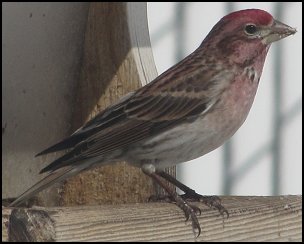
Still, I saw the first sign of spring in my backyard several days ago with the reappearance of the Cassin's finches - at least two pair, with the brightly colored males and boldly marked females both visiting the feeders and snacking on hulled sunflower seed. Theoretically, Cassin's finches are found in Utah year-round, but that has never been the case in my yard. They will visit for a few weeks to take advantage of the food and shelter I provide, but as the trees begin to embrace the warming season they will disappear to better nesting areas and more natural food sources.

Despite the season's delay, migrants are starting to appear - I've noticed a few yellow-rumped warblers flitting about the trees nearby, and the numbers of birds at my feeders are beginning to rise. Hopefully this pause in the season will be over soon, and I'll have more than the one rosy sign of spring my yard has thus far seen.